Showing posts with label history. Show all posts

Monday, 19 January 2026

The Historical Bowden Bridge


A beautiful 3-arch bowstring bridge near Borden, Saskatchewan.  


Now closed to vehicular traffic, many come to fish or simply enjoy the walk across this handsome historical rainbow arch bridge.    


For the first time ever I was able to just enjoy it with no snow on the ground. Yay!


Michael Truman

Thursday, 11 December 2025

Tyra

Grrrrr!


Tyra stands 85 feet tall, 150 feet long and weighs in at 145,000 pounds . . . and is a landmark in Drumheller, Alberta.  

Unfortunately, there are plans to dismantle this iconic structure in the near future. Can't imagine what they're thinking . . . everyone wants to see Tyra and no one wants to see her gone.

Maybe they'll come to their senses.  

Photographed in Drumheller, Alberta on October 22, 2025.

Michael Truman

Monday, 8 January 2024

Abandoned

A long abandoned gas station in Landa, North Dakoka.


Imagine pulling up in your 1949 Ford convertible on a Friday night.


"Fill 'er up!" Then off to the drive-in theatre. Good times.

- Michael Truman

Friday, 4 March 2022

Pumpkin Park

Welcome to Pumpkin Park in downtown Smoky Lake, Alberta.


On a trip through Smoky Lake it's most likely I'll pick up a bacon cheeseburger at Betsy's Burger Shack and then head down to Pumpkin Park to enjoy it.  They're both great little stops along the way.

And right next door is the old train station...bonus!


- Michael Truman

Friday, 14 May 2021

1936 Ford Fire Truck


A "caged" 1936 Ford fire truck at the Melville Heritage Museum in Melville, Saskatchewan.

The building is the former Luther College built in 1913.


- Michael Truman

Thursday, 22 April 2021

Into the Hoosegow with You!

Drunk and disorderly conduct? Into the hoosegow with you!

- Michael Truman

Wednesday, 13 January 2021

Braddock Town Hall

Braddock Town Hall was established in 1927 . . .


. . . and is the home of the annual Harvest Stomp in October.

Braddock is near Gouldtown, Saskatchewan.

- Michael Truman

Wednesday, 16 December 2020

McCormick-Deering

A few shots from this past summer when it was warm and green.  An antique McCormick-Deering tractor with plow at the entrance to a farm yard near Crystal Springs, Saskatchewan.  

Note how the rear wheels have been "modified" with rubber tire treads.

If you're ever in the area, there is a hotel restaurant in Crystal Springs that serves delicious homemade pizza . . . definitely worth the stop.

- Michael Truman

Wednesday, 30 September 2020

Six Horse Plow

A monument that incorporates a six horse plow from 1930 and a steam locomotive bell donated by the C.N.R. in 1950.  Celebrate Saskatchewan!

Photographed in Hoey, Saskatchewan.


- Michael Truman
Past Presence Website


Thursday, 10 September 2020

The Hidden Lives of Ghost Towns

This CBC News article may be of interest to anyone curious about Alberta's past:

Monday, 9 December 2019

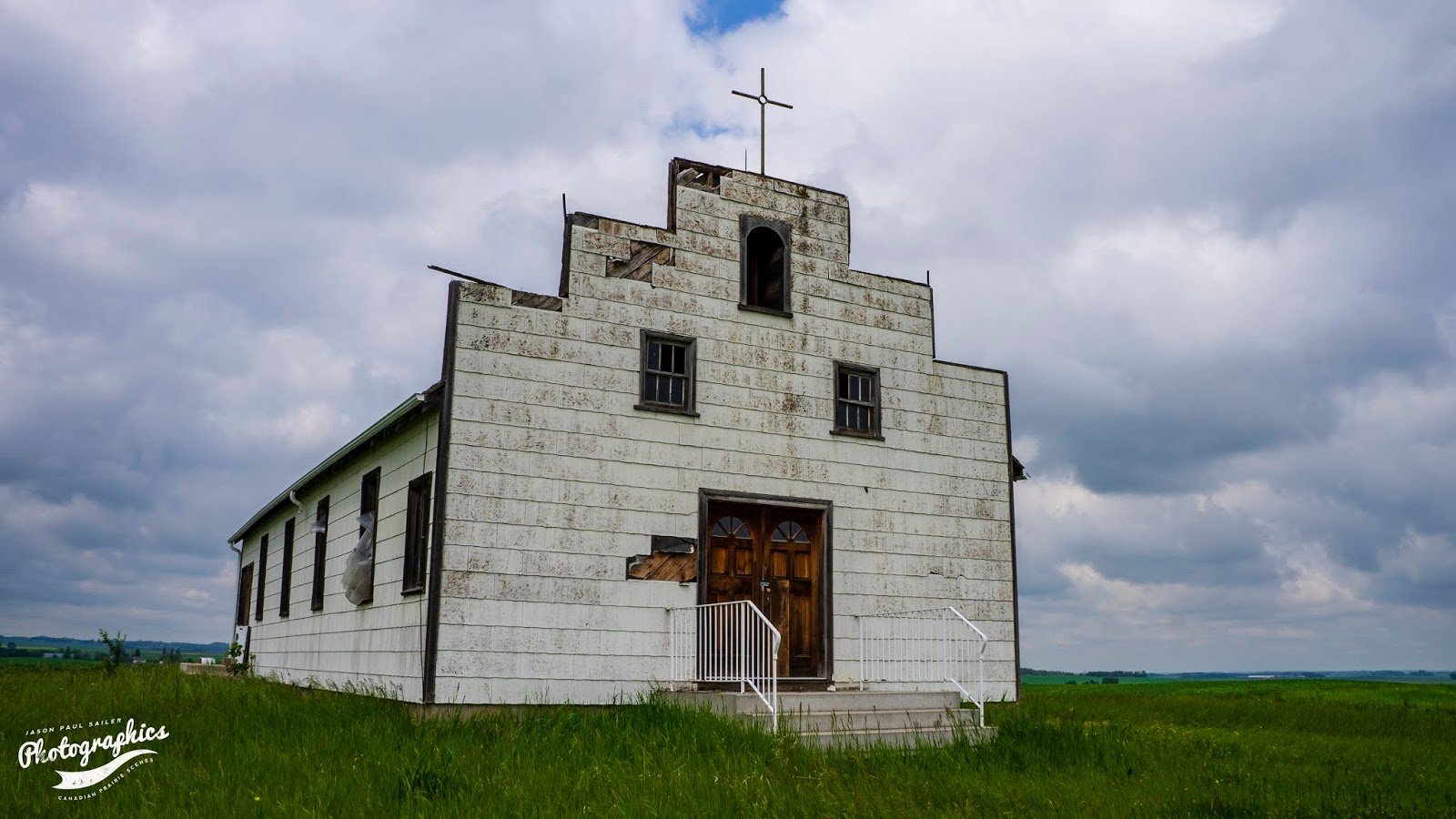
St Michael’s Catholic Church

St Michael’s Catholic Church, also known as Manfred Hungarian Church, was built in 1910. The church steeple was lost to lightning in 1935. The church received a major renovation in 1955. The church was closed in 1975 – visited in June 2019, located in Ponoka County, AB


- Jason Paul Sailer

Friday, 6 December 2019

Canada Truck

Pictured is the 1958 CANADA TRACTOR TRUCK, which was a joint effort of Leyland Motors (Canada) Ltd. and the Canadian Car & Foundry Company Ltd. (Fort Williams plant). It was designed/built in the mid-1950s and was unveiled on July 1, 1958, using a Leyland 680 Diesel engine, an International Harvester Comfo-Vision cab, a Spicer 5-speed (low/high range) axle, and a custom-built chassis. It was designed to compete with other semi-trucks of the day. However after its debut, not much is known on what happened or if any sales did occur. It later disappeared from history and was later re-discovered a few years ago in an Edmonton-based trucking company lot parked out back, and it was determined it was unique enough it deserved preservation. The truck was acquired by the Reynolds-Alberta Museum, and their Head of Restoration, Darren Wiberg, is personally working on this one-of-a-kind truck, which is believed to be the only actual truck in existence, after finding a serial number of 1008-01 on the vehicle, and extensive searching online to find no other trucks made.

Many of the parts are one-off, so Darren and his small team have to duplicate what is left on the truck or scour the internet to find parts in faraway places, for example, he had to order an engine kit from a company in India, and other parts from a different company in the United Kingdom. The truck came to the museum in rough shape, but with Darren’s skills, it will be back in running shape in no time! He plans on having it done in the next year or so, depending on if he needs more parts shipped from overseas companies, which take a while and cost a lot of money. Darren mentioned they did find a black and white photo of the truck and it was painted in red & white colours, so the final product will be painted the same with a large CANADA badge on the front grille. I was lucky to go into the restoration shop at the museum on my visit in mid-June and get up close and personal with the truck. A unique piece of Canadian history!


- Jason Paul Sailer

Monday, 2 December 2019

Patriotism

Several companies over the years have used patriotism (by incorporating Dominion or Canada in the names or products) to help build up their business efforts, including the Montreal-based Dominion Bridge Company. One of its divisions, Manitoba Bridge and Iron Works, had several products available for purchase including bridges, structural steel, fire escapes, fasteners, railings, water tanks, roof trusses, coal mining equipment, casting, forging, and weigh scales, such as this one in the 1906 Hobbema Alberta Grain Company wooden elevator on display at the AB Central Railway Museum (located east of Wetaskiwin, AB) - Visited in June 2019


- Jason Paul Sailer


Monday, 15 July 2019

St. Mary’s Roman Catholic Church (Immaculate Conception) - Tide Lake, AB

In 1909-10, settlers began arriving in the Tide Lake area, and often met on Sundays for worship and fellowship in alternating homes, while money was being raised for a new church. In 1912, land for the church was donated by a local area farmer, and with the help of the parishioners, a small church was built and opened in December 1912. As with many country churches, many events were held at the church including weddings, funerals, meetings, birthday’s, baptisms, among other things.

In the late teens/the early 1920s, there were a few years of bad crops and drought which caused some of the original members to sell their farms and move to the urban centers, so the remaining congregation scraped together to keep the church in operation. In 1927, a house and store belonging to a former church member were purchased and moved to the property and was renovated into the existing structure. Things were starting to look up!

Then the Great Depression hit, causing more farms to close up and several of the families to move away. The remaining members of the church had to tighten their belts again to keep the services going, though by this point the services were held once a month instead of once a week to help save costs. Although the paint peeled, shingles curled, windows rattled, and the dust sifted in with each passing windstorm, the church remained firm. With the start of the Second World War, some of the families son’s went off to serve in the military. It wasn’t until after the war that the local population slowly grew and some new families were added to the church membership. Regular weekly services commenced in 1956, with a priest driving out from Tilley to conduct the services. Around this time, the church was renovated and a power generator was installed to supply electricity for lights, along with a new oil heater.

In 1967 Calgary Power (now Trans-Alta) was installed at the church and a new forced-air furnace. In 1971, the Catholic districts were reorganized, and the priest made the trip out from Medicine Hat for the services. In the early 1980s, the original cemetery was extensively restored and cleaned up (located across the road from the church). Additional renovations occurred in the 1980s and early 1990s. The church is still in use and is currently administered by the Saint Mary’s Roman Catholic Church out of Brooks, AB. Visited in April 2019 and located in Cypress County, AB.

Various internet sources.


- Jason Paul Sailer
Thursday, 20 June 2019

CNoR / CN Abandoned Rail Line

In early May 2019, we traced the CNoR / CN abandoned “Peavine” proposed rail extension northwest of Suffield, AB, stopping to photograph some ruins and rusty metal along the way.


The rail extension was proposed to go from Hanna, AB heading south towards a point by the Red Deer River, called Steveville. At the river, the railway line would cross over and zig-zag through the badlands and eventually head southeast over the plains towards Medicine Hat. The CNoR hoped to serve the growing farming base in the area and tie into the new industries in the City.

Construction began in 1914 heading south, but with the start of the First World War and eventual labour/material shortages forced CNoR to suspend work on the line. Work restarted in 1918, but with low wheat prices, CNoR decided to concentrate their efforts on the stretch of track from Hanna to Wardlow first before progressing southwards. Their hard work was rewarded with a train reaching Cessford in December 1919, and by 1921 reaching Wardlow just within view of the Red Deer River. At the river, work was slowly progressing on a massive bridge structure and railbed grading was occurring from the river southeast towards Medicine Hat. Sidings were proposed after the river crossing; Dinosaur, Gilburn, Princess (a diamond crossing with the CPR Empress subdivision track), Pennymac, Bemister, Learmouth, Sinensen, Kalbeck, Stair (another diamond crossing with the CPR Brooks subdivision) and then through Redcliff into Medicine Hat, either by an separate track or possibly sharing CPR trackage.

However, with the low wheat prices and a series of droughts / frozen crops forced several farmers to sell out and move into the urban centers. As well, CNoR’s reorganization into Canadian National (CN) added headaches and additional hurdles to overcome, along with CPR becoming more hostile to the idea of having the competition within range of its client base. The CPR would do everything possible to delay or stall CN’s efforts. The final blow to the Peavine was the Great Depression which further escalated the mass exodus of farmers from the region. CN continued on with the remaining trackage of the Sheerness sub, until getting approval from the government to abandon the track from Cessford to Wardlow in December 1977, and the remaining trackage from Cessford to Batter Junction (outside of Hanna) would be abandoned in January 1992. The photos were taken near the proposed siding named “Pennymac”.


- Jason Paul Sailer

Sunday, 16 June 2019

Wednesday, 12 June 2019

Osborne School District #2520

This one-room school was opened in 1912 and operated until 1955 when it was closed and the area students were bussed to Jenner, Alberta. The teacher lived not far from the school in a two-room teacherage building (just to the north). The school was later used as a community hall for a while and now sits empty and forgotten. Located in Cypress County visited in May 2019


- Jason Paul Sailer

Tuesday, 11 June 2019

Abandoned House - Cypress County, AB

I found an abandoned house on the way to look at a country church and an abandoned one-room school - Photographed in April 2019 in Cypress County, AB

https://www.facebook.com/JasonPaulSailerPhotographics


- Jason Paul Sailer

Monday, 25 February 2019

Zion – Wheatwyn Lutheran Church, Saskatchewan

Paraphrased from:

https://www.historicplaces.ca/en/rep-reg/place-lieu.aspx?id=7065&pid=0

Around 1900, a small group of German Lutheran immigrants settled in this district. They held informal church services on the neighbouring farms and established Zion Evangelical Lutheran congregation in the spring of 1906. A cornerstone was laid in the late summer on land donated by one of the original members, John Lingner, and construction began soon afterwards. The church was dedicated on November 3, 1907, and regular services were held there until 1961 when the congregation merged with St. Mark’s Lutheran Church in nearby Markinch. The church is still used for special services, funerals, weddings, etc. It is designated a municipal heritage property in January 1982, and a provincial heritage site in July 2005.


Heritage value resides in the church’s stone construction and Gothic Revival architecture. Constructed from local field-stone, the church includes three symmetrically-placed pointed arch windows on each side, and a cupola facing the east. Visited in January 2019, located in the Rural Municipality of Cupar, Saskatchewan.


- Jason Paul Sailer